



.avif)


The rise of artificial intelligence is fundamentally reshaping how AI data center infrastructure is designed, deployed, and scaled.
Unlike earlier waves of cloud computing, AI workloads introduce significantly higher demands across compute, power, and cooling. As a result, scaling infrastructure is no longer just about adding capacity - it requires a more deliberate approach to designing systems that can support increasingly complex and resource-intensive environments.
What is emerging is a new model of infrastructure, one that is purpose-built for AI, shaped by its requirements, and constrained by its operational realities.
What Defines Modern AI Data Center Infrastructure Design?
At the core of AI data center infrastructure design is a shift away from generic environments toward systems that are tightly aligned with workload requirements.
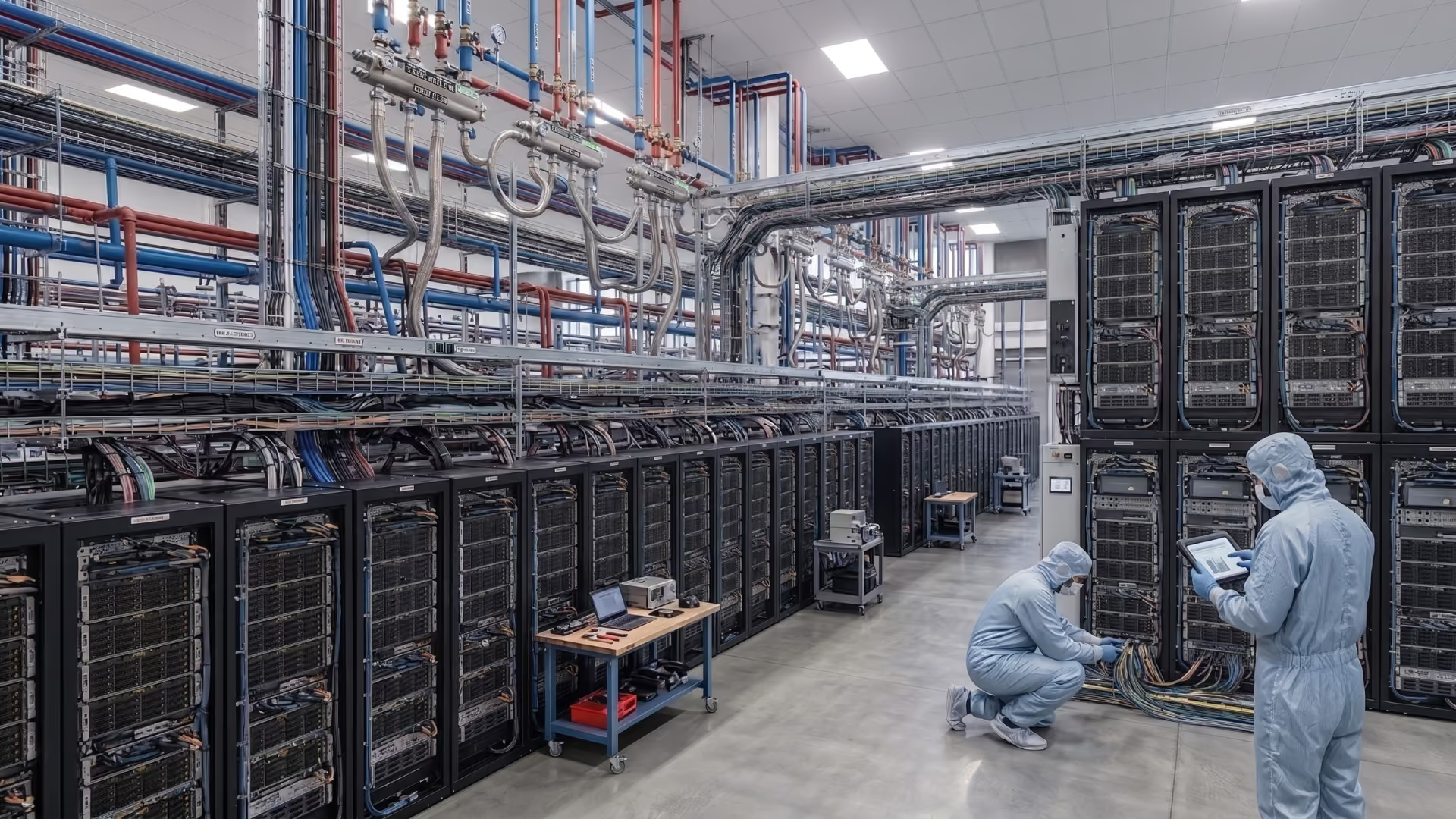
AI workloads, particularly those involving large-scale model training, require high-performance computing environments built around GPU clusters for AI. These clusters process vast amounts of data in parallel, demanding significantly higher power density and faster interconnect speeds than traditional server setups.
This is changing how facilities are configured. Rack layouts are being redesigned for higher density, while network architectures are evolving to support low-latency, high-bandwidth communication between GPUs.
Rather than acting as a passive layer, infrastructure is now being actively shaped by the compute it supports.
What Are the Key Scaling AI Infrastructure Challenges Today?
Despite strong demand, scaling AI data center infrastructure is becoming increasingly complex.
One of the biggest scaling AI infrastructure challenges is that expansion is no longer linear. Instead of large, one-time deployments, infrastructure is now built in phases to manage massive power requirements and significant supply chain lead times.
This phased approach introduces new dependencies. Delivering AI-ready environments requires tight coordination across power systems, cooling technologies, networking, and specialized hardware such as GPU clusters. Delays in any one of these components can slow overall deployment timelines.
As a result, execution has become just as critical as demand in determining how quickly infrastructure can scale.
How Are GPU Clusters for AI Changing Infrastructure Requirements?
The increasing reliance on GPU clusters for AI is fundamentally altering infrastructure requirements at every level.
Training workloads typically require large, centralized clusters optimized for maximum throughput, while inference workloads are more distributed and latency sensitive. This distinction is pushing operators toward more specialized infrastructure designs.
Instead of building uniform environments, operators are developing tailored systems optimized for specific workload types. This allows for greater efficiency, as infrastructure is designed around actual usage rather than theoretical peak capacity.
In effect, the rise of GPU clusters is driving a more nuanced and differentiated approach to infrastructure planning.
Why Is Data Center Cooling for AI Workloads a Critical Constraint?
As compute density increases, data center cooling for AI workloads has become one of the most critical constraints in modern infrastructure design.
Traditional air-based cooling systems are often insufficient for handling the thermal output of high-density GPU clusters. In response, many operators are adopting liquid cooling solutions, which are more effective at dissipating heat in these environments.
This shift is not incremental, but rather foundational. Cooling is now a core component of AI data center infrastructure, directly influencing performance, reliability, and scalability.
Innovation is also moving closer to the hardware layer, with growing interest in integrating cooling mechanisms directly into system design. As AI workloads continue to evolve, cooling will remain a central factor in shaping infrastructure decisions.
How Is System Integration Evolving in AI Data Center Infrastructure?
Another defining feature of modern AI data center infrastructure is the increasing level of integration across systems.
Historically, compute, networking, and facility infrastructure were often developed independently. Today, these components are being designed in tandem. Decisions around GPU cluster configuration, network topology, and facility layout are deeply interconnected.
This integrated approach enables operators to optimize performance at a system level, ensuring that each component contributes to overall efficiency and scalability. It also reflects a broader shift toward designing infrastructure around workloads, rather than retrofitting environments after the fact.
Why Execution Complexity Is Slowing AI Infrastructure Deployment
While technological advancements are enabling more powerful systems, they are also introducing new layers of complexity.
Building AI-ready infrastructure requires aligning multiple specialized components, each with its own constraints and dependencies. From GPUs and networking equipment to cooling and electrical systems, delays in one area can impact the entire deployment timeline.
This makes execution a key bottleneck, and one of the most important scaling AI infrastructure challenges facing the industry today.
How Are Operators Building Flexible AI Data Center Infrastructure?
Given the rapid pace of AI innovation, flexibility is becoming a critical design principle.
Operators are increasingly developing AI data center infrastructure that can adapt to changing hardware requirements and evolving workloads. This includes designing facilities that can support different types of GPU clusters and accommodate future advances in AI technologies.
Rather than relying on fixed configurations, the focus is shifting toward modular and adaptable systems that can evolve over time. This reduces the risk of obsolescence and allows infrastructure to remain relevant in a rapidly changing landscape.
Future Outlook for AI Data Center Infrastructure Market
AI is pushing infrastructure into a new phase defined by density, specialization, and integration.
AI data center infrastructure is no longer just a supporting layer - it is a strategic enabler of AI capabilities. At the same time, growth is increasingly shaped by real-world constraints, from cooling limitations to execution complexity.
Understanding these dynamics is essential for navigating the next stage of the market. The future of AI will depend not only on advances in computing, but on the ability to design and scale infrastructure that can support it effectively.
Interested in Learning More About the AI Data Center Infrastructure Market?
To explore how leading operators are designing GPU clusters for AI, addressing scaling AI infrastructure challenges, and innovating data center cooling for AI workloads, access the full expert discussion for deeper, practitioner-led insights.
Additionally, connecting directly with the practitioners who are actively designing, powering, and operating these complex facilities through a GLG expert call provides the nuanced, real-time data you cannot find in a public search.
Check out our other article: Sustainability & Energy Strategy
If you would like to speak 1-on-1 with data center operators, site-selection specialists, or infrastructure supply chain experts to unpack the nuances of the data center market, please contact us below.
Contact Us
Enter your contact information below and a member of our team will reach out to you shortly.