


.avif)


Chiesi is an international specialty pharmaceutical company that creates, develops, and commercializes innovative medicines in respiratory and primary care, neonatology, and rare disease and special care. Chiesi's research centers and laboratories in five countries collaborate on pre-clinical, clinical, and registration programs, with 515 of their 4,100 employees dedicated to R&D. In 2014, the company reported revenue approaching $1.5 billion.
Brett Fleshman is responsible for growing Chiesi by acquiring new products and companies. The job requires developing a deep understanding of a drug, a market, a disease, and a patient - and creating a framework for that drug's value if it reached its potential. This work can only be based on expert opinion, which Fleshman and Chiesi gather through market research projects, medical society meetings, larger advisory boards, and - critically - on-on-one learning. Fleshman starts his research with direct conversations with doctors and scientists to build an immediate knowledge base before determining whether or not to pursue the costly and time-consuming intensive research process that follows. On-demand learning enables Fleshman to avoid investing in bad ideas, advance good ones quickly, and gives him the bandwidth to cast a broader net.
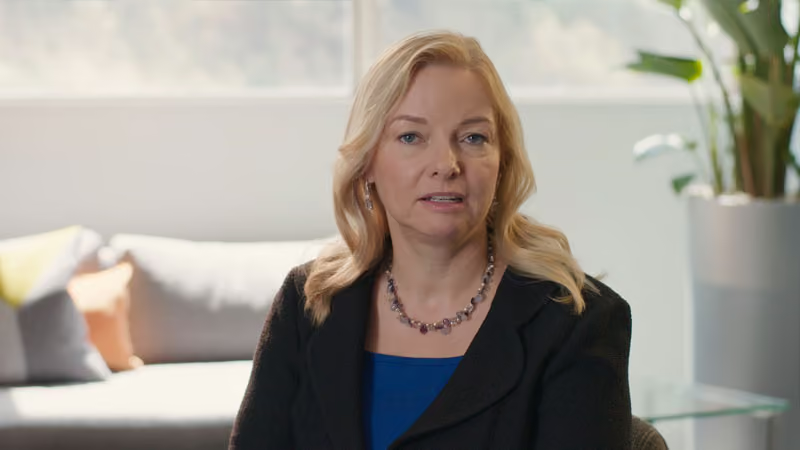
My name's Brett Fleshman. I am Senior Director of Strategy and Corporate Development for Chiesi U. S. A.
The funny thing about valuing a drug is that you have to understand so many things that simply are not written anywhere. There's no web page for it. There's no report you can buy. I have to understand if this drug has reached its potential, if it can be used in a broader patient population, if there are limitations that we perhaps aren't aware of, and most importantly, if there's value that we can take from bringing the drug into our company.
Many times, I would go do that five, six, seven, eight times before I would feel comfortable with proceeding.
Having access to one-on-one learning gives me more bandwidth to address more questions.
The things that I learn in those early stages now are critically important to then making the investment in further market research or pulling together larger advisory boards.
And I find that they're incredibly engaged, so in market research or in focus groups - especially moderated focus groups - I tend to find that the respondents are punching the clock. They maybe agreed to do this a couple weeks ago and are regretting that now.
I do these interviews myself, and I would recommend that for anybody who is my line of work. Once you get one person removed, you start to lose your ability to predict. When I speak with a network member, not only do I get the insights I'm looking for, but I understand how they're answering the questions and how they're thinking. And as you move through a deal and you begin commercializing an opportunity, those types of insights are truly invaluable.
We've been using one-on-one learning to understand the opportunities we're trying to reach through pharma M&A. But we haven't used it yet to understand how we might better do our jobsEto actually use network members perhaps as coaches - individuals who've been through what I've been through in the past, who are very innovative themselves in their approaches. And we could use this as a method of ensuring that we are, you know, benchmarked to the very top of our game so to speak.
It's something I wish I had done at the very beginning of my career.
Contact Us
Enter your contact information below and a member of our team will reach out to you shortly.